
The final whistle at the AFC Women’s Asian Cup 2026 did not feel like an ending.
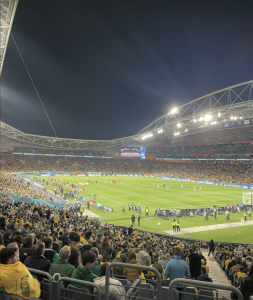
More than 70,000 fans had packed into Stadium Australia, riding every pass, every tackle and every near miss as the Australia women’s national soccer team fell just short of a long-awaited trophy. Across the country, watch parties spilled into pubs and living rooms and, for a moment, women’s football once again felt like the centre of the sporting world.
But as the noise faded and attention shifted elsewhere, a familiar question quietly returned: what happens next?
While major tournaments continue to ignite interest in the Matildas, that surge of attention has yet to translate into something more permanent for the A-League Women. For one of Australia’s most recognisable football voices, broadcaster David Basheer who has covered the game for decades, the pattern is familiar.
“On the national team, you get a sugar hit,” he tells upstart. “Every couple of years there’s a major tournament and Australia gets behind the team.”
That support is immediate and emotional, driven as much by national identity as it is by the sport itself. The FIFA Women’s World Cup 2023 showed just how powerful that connection can be, turning the Matildas into one of the country’s most visible and celebrated teams almost overnight. The Asian Cup, held on home soil, only reinforced it.
Turning that moment into lasting engagement with the domestic game is a different challenge entirely.
“That curiosity about the domestic league is there,” Basheer says. “But that has not translated to full-blown support as yet, and that’s a very difficult transition to make.”
If the problem were simply a lack of interest, the explanation would be easy. But according to Fiona Crawford, author of The Matilda Effect and researcher whose work focuses on women’s football and sport culture in Australia, interest itself is not the issue.
“We know it hasn’t translated to the A-League Women,” she tells upstart. “We saw an initial bump in crowd figures, but we haven’t seen that sustained. It’s actually fallen away.”
The Matildas operate in a space of constant visibility, broadcast on free-to-air television, amplified across social media and supported by years of storytelling that has turned players into household names. The domestic league, by comparison, still struggles to be seen.
“I think the visibility is very poor,” Basheer says. “There’s a wider gap between the Matildas and the A-League Women than there is between the Socceroos and the men’s league.”
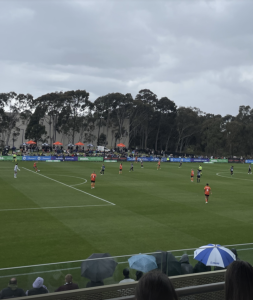
Even when matches are broadcasted, they can be difficult to access, played in smaller venues or scheduled in ways that make it hard for casual fans to engage. For many who were drawn in during major tournaments, the transition from spectacle to routine viewing is anything but seamless, Crawford points out.
“You can’t follow a team that you can’t see,” she says.
Yet visibility is only part of the problem. During international tournaments, fans learn players’ stories, follow their personalities and invest in their journeys.
The A-League Women has struggled to replicate that connection.
“It hasn’t really found its personality,” Crawford says. “It hasn’t really elevated particular players or catered to the audience in terms of the content they’re after.”
Another factor is that many of the Matildas’ most recognisable names now play overseas, particularly in Europe’s top competitions. The attention generated by the national team increasingly flows towards overseas clubs rather than the Australian domestic league.
Instead of strengthening the league’s identity, the success of its players abroad can make it feel like a stepping stone, something to pass through rather than invest in.
“A lot of those top players came through the W-League,” Crawford says. “But we didn’t keep investing in it, or in the things around it, like visibility and full-time professionalism. That’s why we’re starting to see that gap.”
For Basheer, it’s about starting to tell the origin stories.
“Remind people where these players started, their first clubs, their journeys,” he says. “People want to know those stories.”

Beneath these challenges sits a more fundamental issue: the structure of the league itself. Limited investment, short seasons and semi-professional conditions continue to shape what the A-League Women can offer to players and fans.
“If players can’t be full-time athletes all year, the quality of the game is not going to be as good,” Crawford says. “And when the quality of the game is not as good, you’re not going to be able to attract and retain crowds.”
The issue may also be structural, she says.
“We’re kind of taking the A-League [Mens] footprint and then just doing it as a smaller, lower-budget version,” she says. “And that’s not really serving anybody at this point.”
For all the attention generated by events like the World Cup and the Asian Cup, the work of sustaining a league happens away from the spotlight. It is slower, less visible and far more complex than the surge of excitement that comes with a major tournament.
Basheer believes part of the answer lies in connection, not just at a national level, but within communities. Engaging multicultural audiences, particularly those represented during tournaments like the Asian Cup, could offer a way to build more consistent support.
“The Matildas are the shiny, exciting thing,” Crawford says. “But the hard work is actually in the day-to-day stuff, which is not glamorous.”
The Matildas have already shown what is possible when visibility, storytelling and investment align. They have captured a nation’s attention and, in many ways, changed the perception of women’s sport in Australia.
Whether that attention can be sustained is another question entirely.
Story: Rayan Rashid is a second-year Bachelor of Media and Communications student majoring in Sports Media/Journalism at La Trobe University. You can follow her on X at @rayanrashidd.
Photo: ALW Melb Derby at AAMI Park. Image by Author. This image has not been modified.