“It’s a bit unfair,” university student Billy McWhinney tells upstart.
“It just doesn’t make sense why we have to pay the money where people didn’t have to in the past, and they would have a lot more time in person.”
McWhinney, who is undertaking an Honours Law degree and a Bachelor of Psychology at La Trobe University, will have to pay $67,000 in tuition fees over the course of his five-year degree. If he was born just 40 years earlier, he would’ve been able to graduate without paying a cent.
In 1974, Gough Whitlam‘s Labor government introduced a policy that made university free for all Australians. An average of 336,000 students’ attended university a year before the policy was abolished in 1989.
In the lead up to the 2025 election, the Greens pledged to make university free for all Australians once again. Meanwhile, this year the Free TAFE Free Uni Party was launched. As more political parties begin to support free education, the debate continues about whether Whitlam’s free education policy was successful, and if it could ever return. If you ask founder and secretary of the newly formed Free TAFE Free Uni party, Thomas Dolan, he’ll tell you it would change Australia for the better.
“Free tertiary education would remove barriers to education for the next generation of Australians and would benefit both the individual and society as a whole,” he tells upstart.
However, higher education policy professor at Monash, Andrew Norton, is more sceptical about Whitlam’s policy.
“I would say it had a modest impact overall,” he tells upstart.
“Most full-time undergraduates already had scholarships that paid their fees, which were low by today’s standards.”
Although enrolments nearly doubled over the free period, Norton is unsure if it’s linked to the change in funding, which had already started increasing before university was made free and continued after fees were introduced in 1989.
One positive was that it helped to achieve gender equity at universities.
“A lot of people say it made a big impact, particularly [for] women,” Norton says.
During the 14 years university was free in Australia, women went from representing a third of all tertiary students to a little over half. However, the positive trend in female enrolment can’t be attributed to free university alone, as enrolment among women at tuition-funded US universities saw a similar trend over the same period. The trend has continued even after fees were reintroduced.
While Dolan agrees that a change back to free education would be radical, he has a better solution for how to fund it.
“It’s a political choice and it’s an economic choice,” he says.
“We [could] get that money by taxing our gas exports and actually having royalties or tax revenues on our mining exports,” he says. “Australia is an incredibly wealthy nation.”
“If we stop giving away our resources… then we’d be able to raise that revenue.”
Dolan is also aware it would take a mass political movement to change the system, the kind that gets people talking at pubs and calling their local politicians or “for it to become political suicide not to support it”.
Dolan is not the first to argue that higher tax on the gas and mining industry is needed in Australia. It was famously pointed out by independent senator David Pocock in February that tax on beer brings in almost double the amount raised by tax on gas exports. Dolan says that HECS repayments are playing a similar role, bringing in $4.9 billion to the federal government in 2023 compared to the $2.2 billion generated from the petroleum resource rent tax (PRRT).
“And the question is… why are students subsidising the mining industry?” he says.
However, the question of how to fund free education is not a new one. In 1989, regardless of higher enrolments, Prime Minister Bob Hawke was forced to reintroduce fees. Norton attributes this to an increasing number of Australians completing high school, paired with a population bubble, which meant the most common age for an Australian in 1989 was 18.
“The government could see there was going to be a huge increase in demand for higher education,” he says.
“They were also trying to maintain a fairly tight budgetary situation… introducing this income contingent loan (HECS) was, I think, the political solution to it.”
As a result of the 1989 reforms, the Higher Education Contribution Scheme (HECS) was born and a flat $1,800 yearly fee for undergraduate students was introduced.
Despite the introduction of fees, enrolments jumped by ten per cent per year in the two years after, before settling between one and five per cent increases over the following ten years.
More recently, university fees have risen significantly due to deregulation and schemes like differential HECS and the Job-Ready Graduates package. According to Norton, the Job-Ready Graduates Package is to blame for some degrees being more expensive, such as Business and Arts. He says the government was aiming to steer people’s course choices.
Yet, even with the rise in costs, university enrolments are at a record level high, with over 6 percent of the population attending some form of tertiary education in 2024. In Norton’s view, the rise in participation is a direct result of “not staying on the free path”.
“This seems like a paradox, but it is not,” he says.
“If free higher education had remained, I think enrolment growth would probably have continued but at a lower rate, because a government worried about its financial position would have put tighter caps on student numbers.”
HECS provided a solution, by limiting government expenses and allowing for more university places.
But Dolan argues that high enrolment numbers shouldn’t necessarily be the end goal.
“Not everyone needs a university degree,” he says. “The point should be that… cost should not be a factor in not getting a university degree.”
Article: Matias Birkeland is a second-year Media and Communications (Journalism/Sport Media) student at La Trobe University. You can follow him on Twitter @MatiasBirk3land
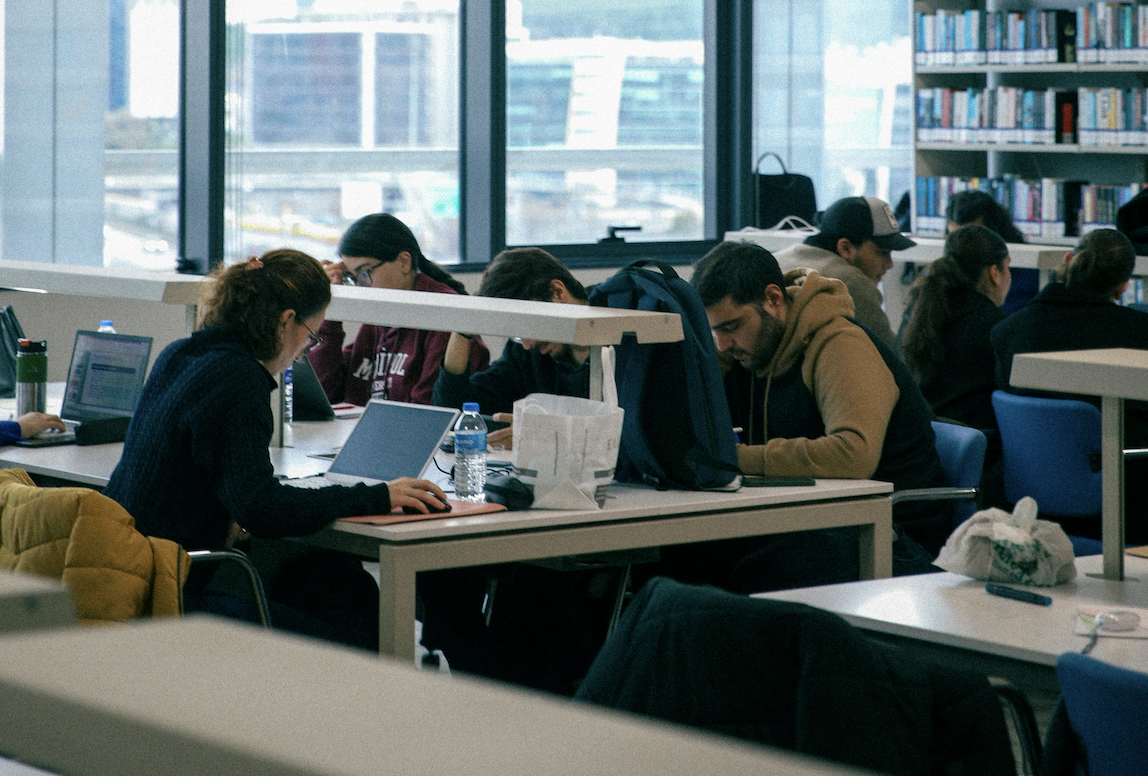
Cover photo: A group of students focused on studying in a well-lit modern library setting by Yusuf Çelik available HERE. This image has been cropped.